chunkmirage
Spoof chunked array formats over HTTP with on-the-fly processing.
▶ Try the demos in your browser All demos
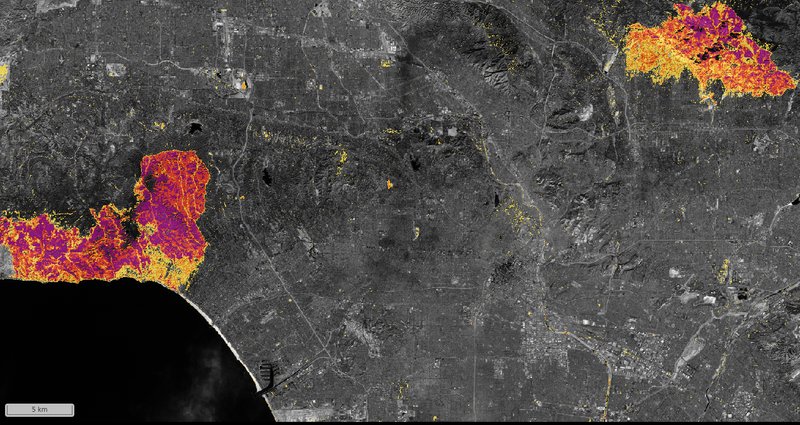
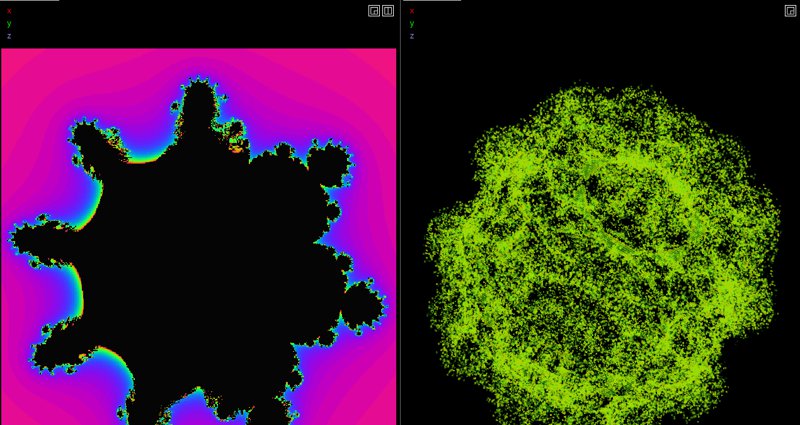
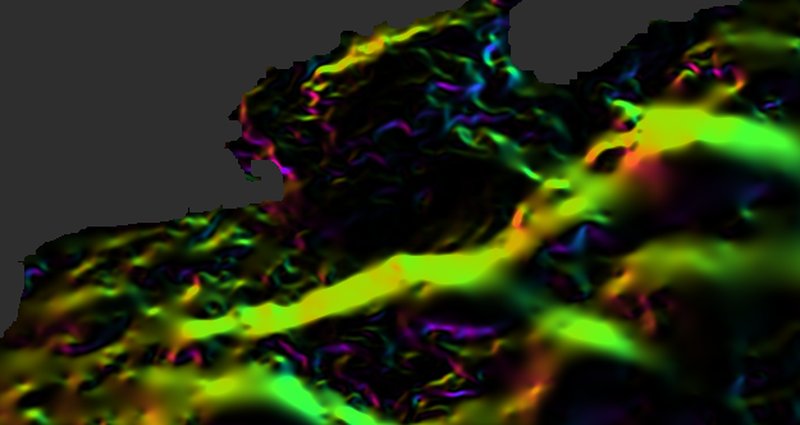
chunkmirage serves virtual datasets that look, to any HTTP-capable viewer or library (Neuroglancer, BigDataViewer/Fiji, vizarr, napari, dask, tensorstore, ...), like ordinary Zarr v2, Zarr v3, N5, or Neuroglancer Precomputed volumes. Nothing exists on disk. Every chunk is computed when requested: read from a real source, pushed through a pipeline of ops, encoded in whatever format the client asked for, and cached so that tweaking a parameter downstream never re-reads or re-computes upstream stages.
viewer / dask  --HTTP-->  chunkmirage  --tensorstore/h5py-->  real data (zarr/n5/precomputed/hdf5; file/s3/gcs/http)
                             |
                             +-- pipeline: source -> [op, op, ...] -> encoded chunk
                             +-- per-stage chunk cache keyed by pipeline hash
                             +-- frontends: n5 | zarr | zarr3 | precomputed, all served at once
                             +-- REST API for live pipeline edits
chunkmirage was inspired by example-virtual-n5, which serves N5 chunks computed when a viewer asks for them, and by cellmap-flow, which grew out of example-virtual-n5 and serves live model inference the same way. chunkmirage makes that trick general: any format, any source, any per-chunk computation, for any client. It is a general-purpose tool: any viewer or library that reads chunked arrays over HTTP, any source format, any per-chunk computation. See the demos, which run in your browser with nothing to install.
When to use it
Use chunkmirage when you want to look before you compute on data too large to process speculatively, and the operation is one a viewer's shader cannot do:
- non-local: filters, morphology, distance transforms;
- learned: model inference where GPU and weights live server-side;
- geometric: resampling under a registration transform (including OME-Zarr 0.6
displacement fields, which viewers cannot apply:
scene://); - multi-source: masking one volume by another, comparing two model versions;
- format bridging: exposing HDF5 or a custom reader as zarr to any viewer.
Nothing in it is particular to microscopy: a time series is an array too, and xarray-written zarr (sea temperature, weather, images of the sun) reads with its own axes and coordinates, so a day-to-day change is an op along time.
The demos also run entirely in the browser, with no server and nothing to install: the gallery has registration solved on your GPU and pipelines of chunkmirage's own ops run in the page (see Demos).
See FAQ for when not to use it.
License and authors
BSD 3-Clause, Howard Hughes Medical Institute. Authors: TBD (collaborative project).
Where next
- Getting started: install, serve, open in Neuroglancer.
- Interactivity: control page, python viewer, how refetching works.
- Caching: what is cached, where, and why some stages are not.
- Formats and URLs: the exact URLs each viewer needs.
- Roadmap: what is planned and why.